
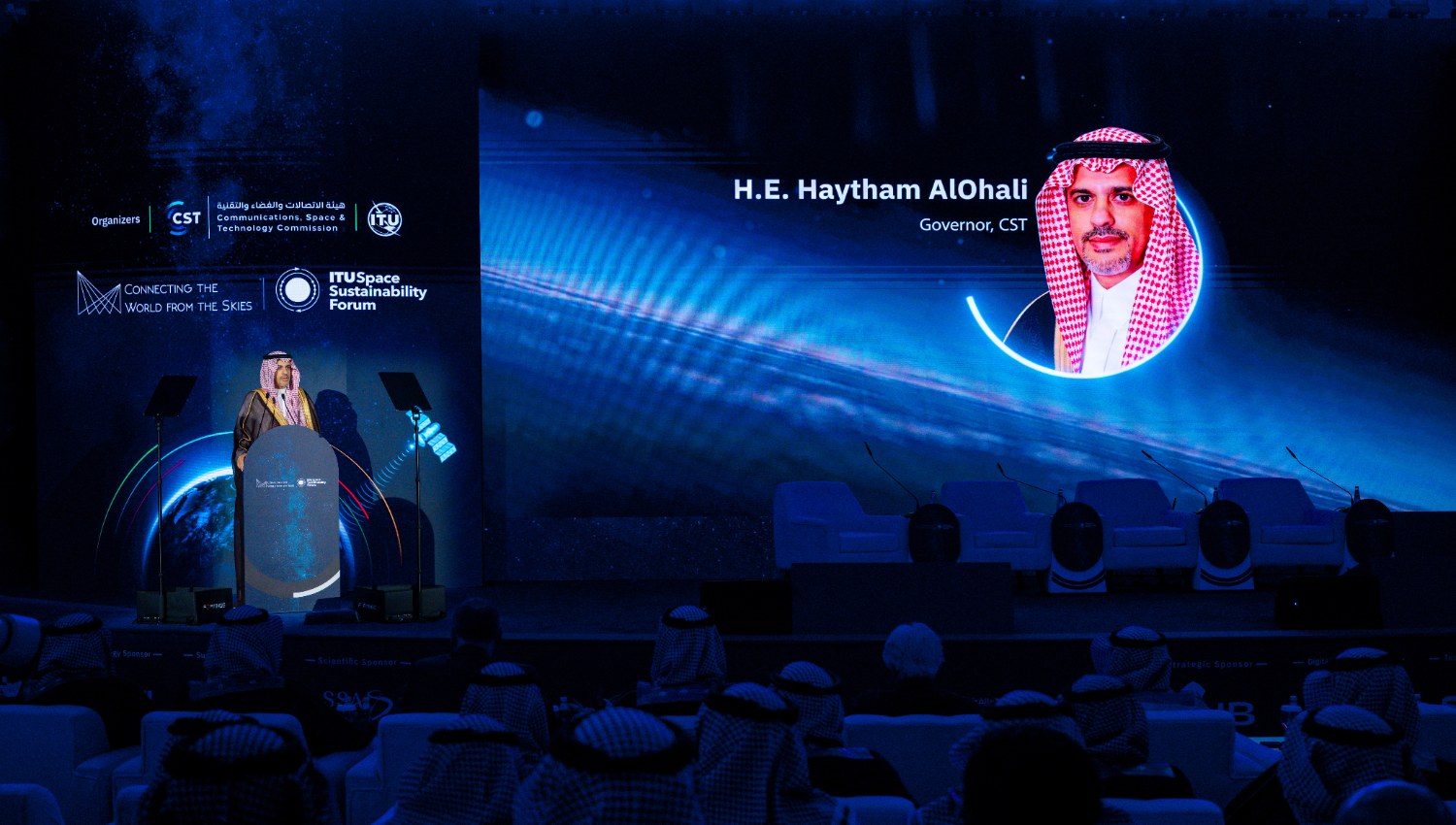

The governor of Saudi Arabia’s Communications, Space and Technology Commission (CST), Haytham AlOhali, has called for closer international cooperation to protect orbital resources as the global space economy expands. Speaking in Riyadh on Monday, 12 October, at the opening of the Global Space Connectivity and Sustainability Events 2026, he cited projections that the sector will be worth $1.8 trillion by 2035.
AlOhali said the space economy is expected to more than double over the next decade, creating commercial opportunity but also adding pressure on the resources that satellite services depend on. Non-terrestrial networks, he said, open new markets while straining spectrum and orbital capacity, which makes a coordinated international effort necessary if space is to remain usable over the long term.
He set out figures to show the pace of change. Satellite network filings at the International Telecommunication Union (ITU) rose by more than 7% in 2025 compared with 2024, and the number of satellites listed in those filings grew by more than 10%. By his estimate, about 10 new satellites and spacecraft are launched every day. “The result is more congestion and more risk of collision,” AlOhali said, adding that losing usable orbits would mean losing the means to connect 2.2 billion people. Global investment in space companies passed $60 billion in 2025, a record, and Saudi Arabia has attracted nearly $180 million.
The three-day event is hosted by CST with the ITU and brings together regulators, device makers, space service providers, experts and researchers. For the first time, the Connecting the World from the Skies Forum and the Space Sustainability Forum are running together under one umbrella. Each forum is now in its 30th edition, and the first two editions of the joint events attracted more than 12,000 participants from over 140 countries. The Kingdom’s Space Hackathon received 700 entries from 54 countries, with finalists due to be named this week. Saudi Arabia is also taking part in the third edition of an international research competition on non-geostationary networks, run with the Institute of Electrical and Electronics Engineers (IEEE), whose first two editions drew 81 papers from 281 researchers and academics.
AlOhali closed by returning to the question of access, noting that 2.2 billion people remain offline. He argued that the benefits of the space economy should reach everyone and said connecting those people is “the test of this economy”.